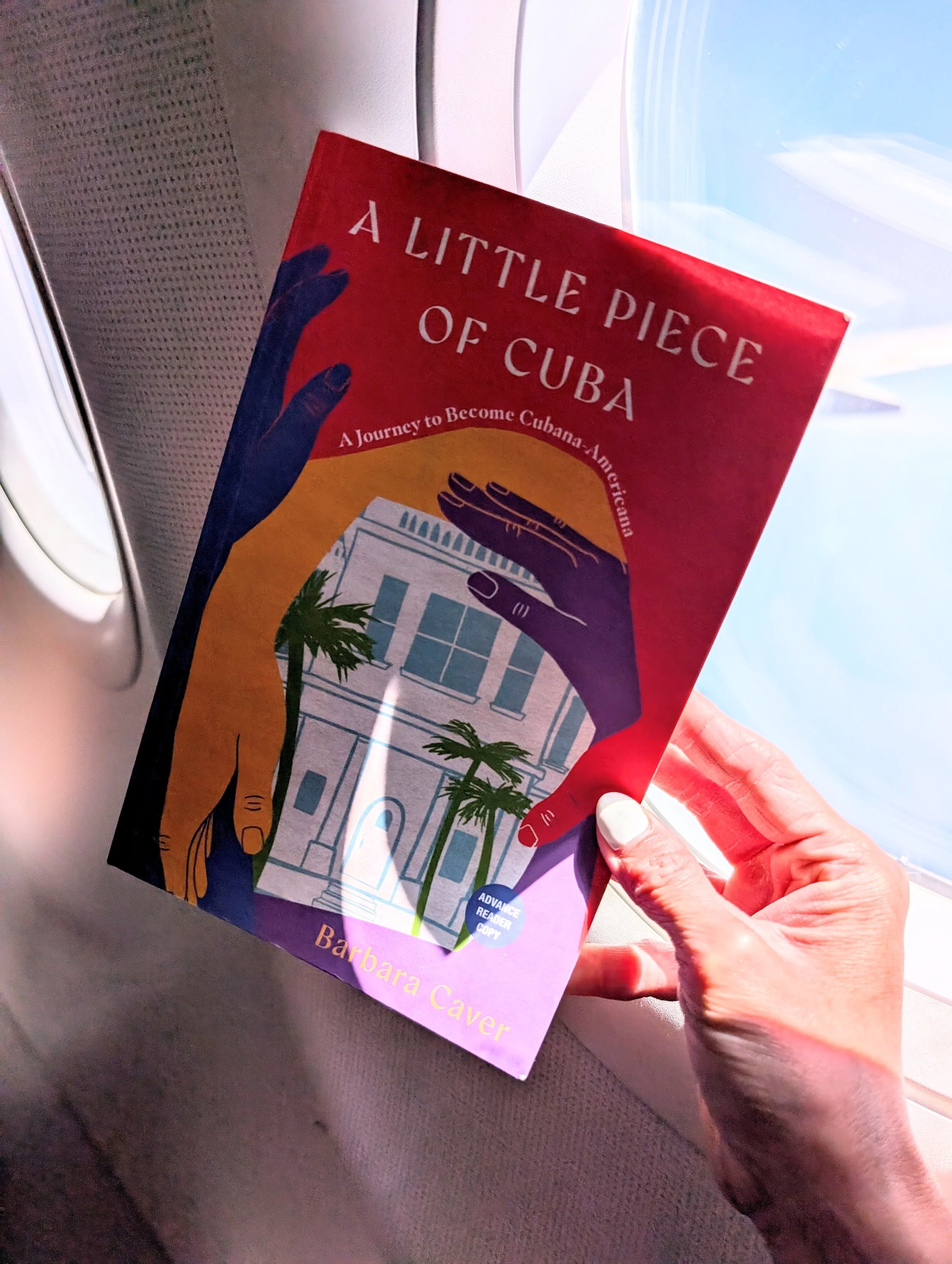
“A Little Piece of Cuba: A Journey to Become Cubana-Americana” by Barbara Caver
“That is part of the beauty of all literature. You discover that your longings are universal longings, that you’re not lonely and isolated from anyone. You belong.”
- F. Scott Fitzgerald
Barbara and I met in New York City through our gym, the Training Lab. The Queen of the Heavy Wall Balls (20-25 lbs minimum), Barb has been someone I’ve looked up to, and while I knew that she had been working on a book in her free time outside of her career as a creative executive in the film & TV industry, I had no idea that she was such a talented writer until I started reading her debut book, “A Little Piece of Cuba: A Journey to Become Cubana-Americana”!
Barbara grew up in South Carolina with a white father and Cuban mother, and “A Little Piece of Cuba” is a memoir centered around Barbara’s first visit to Cuba in 2017 as a 37 year-old woman. In the book, she describes as herself as “the whitest Cuban you’ll ever meet,” and as she goes through her memories growing up in South Carolina and the deep South with her grandparents and her mother - her only real-life connections to Cuba while growing up - and then her first experiences meeting people of Cuban heritage outside of her family when she moved to New York City as a college student at NYU. She considers what makes her feel Cuban, such as food, coffee and religion, and what makes her feel closer to her cultural heritage. At the same time, she is brutally honest about her struggles with Spanish, her awkwardness over pronouncing words incorrectly in her “Southern-laced Spanglish”, and about her anxiety of visiting Cuba for the first time and feeling like a tourist peering in from the outside.
“A week or so before my trip to Cuba, I woke up around two in the morning in a cold sweat. I had been dreaming of Cuba, photoshopping myself against a collage of what I imagined it would be like.”
While reading this book, I felt like Barbara put out there in real words thoughts and feelings that I had felt growing up as a Korean-American in Los Angeles. My parents immigrated to Los Angeles from Seoul, and although I grew up with Korean culture, food and traditions at home, during my adult years, my Korean language skills and connections to Korean culture became significantly diminished as I got caught up chasing education, career and relationships in my 20s and 30s. I put my cultural identity and heritage on the backburner, and my Korean identity had become associated mostly with my childhood memories, rather than being a living, current experience.
Like Barb, I too struggled with language and felt like an outsider when I visited South Korea, and sometimes I feel like I’m cosplaying my Korean identity. Reading Barb’s book, I realized that I am not alone in having these feelings of embarrassment and awkwardness about my connection to Korean culture, and it’s made me pause and consider where I am now with my relationship to my cultural identity and how I want to make it personal to me and not just an imitation of what I grew up seeing in my childhood. As Barbara wrote, “How we live our lives is how we live our culture.”
The book is deeply personal, lyrical in its choice of words, and at times, laugh-out-loud hilarious, and although the book is self-described as a memoir sifting through memories of her past, the theme of the book is universal and direction of the book, forward, as she empowers readers to create their own versions of cultural identity.
“To change my story was the first step; for so long, I had referred to Cuba as something separate from me. I had learned a lot from my family; for my mother and her siblings, Cuba was a memory. For my grandparents, Cuba was in the tiles on the kitchen floor and hanging on the walls of their home, but the walls and the floor are taken for granted and not often noticed. My grandmother’s story, my mother’s story, my family’s story belongs to them. I have my own version of the Cuban American story to tell. ”
The book is now available on Amazon.